
If your labs are normal, why do you feel so bad? Because exhaustion, insomnia, digestive issues, and hair falling out sure don’t feel healthy.
I have worked with over 15,000 patients, and almost every single one had the same story. Normal labs. Terrible life.
I am going to show you the biggest mistake your doctor is making, what your numbers should actually be, and what to do before your next appointment.
What "Normal" Actually Means on Your Lab Report
"Normal" on a lab report means your result landed inside a range the lab calculated from a large pool of people who got tested. The system was built to catch the obvious stuff: anemia, diabetes, organ failure.
Here is what nobody explained to you. The word normal on a lab report has never meant healthy. It has never meant optimal. It has never meant your body is running the way it should. It means average. It means you are not the sickest person in the pool they used to build the range.
And here is why that matters. Average in America right now means 60 percent of the population has at least one chronic condition. Average means tired, overweight, inflamed, and medicated.
When your doctor compares your result to that pool and calls you normal, they are telling you that you fit in with a population that is largely unwell. That is not a clean bill of health. That is a very low bar presented as good news.
The woman who has been exhausted for three years, whose hair is falling out, who cannot sleep, whose gut is a mess, she clears that bar every single time. Her numbers land inside the range. She gets sent home. And the actual problem sits right there on the page, stamped normal, never discussed.
Normal on your lab report just means you are not sick enough for anyone to notice yet.
So what is that number actually being compared to?

Where That Normal Range Actually Comes From
The reference range on your lab report is a statistical calculation. Labs take a large pool of people who got tested and find where the middle 95 percent of results land. That band becomes the range. If your number falls inside it, you are normal.
The people who get bloodwork done are largely people who feel bad enough to go to a doctor. They are tired, symptomatic, already in the system. So the average your result is being compared to is the average of a population that includes enormous numbers of unwell people. You are being measured against sick people and called healthy because you are not the sickest one in the room.
Think of it like grading on a curve where most of the class failed. You scored a 52. Curved against that class, you passed. Your score did not change. The standard you were measured against did.
That is what is happening with your bloodwork. A ferritin of 14 sits inside the normal range. Physiologically, a ferritin of 14 means your body is running on fumes. Your hair falls out. Your legs will not stop moving at night. You cannot think straight by 2 in the afternoon. I know from running labs on tens of thousands of patients that an optimal number for ferritin is different.
Same thing with vitamin D. The standard range calls anything above 20 acceptable. We see patients at 22 with three years of depression, chronic joint pain, and an immune system that cannot hold itself together. We want vitamin D above 60 before we call it adequate.
TSH, which is the only thyroid number most doctors run, is called normal anywhere under 4.5. A TSH of 3.8 can mean your thyroid is struggling, but your doctor sees a result inside the box and moves on.
When you hold a higher standard, lab work tells a completely different story.
What the Right Panel Actually Looks For
A standard primary care panel runs 5 to 10 markers. We run 50 to 80. Every marker we add exists because it tells us something specific about why a person feels the way they feel.
Here is what gets missed on a standard panel.
The full iron picture. Most doctors check hemoglobin. We check ferritin, serum iron, TIBC, and transferrin saturation together. A person can have perfect hemoglobin and a ferritin of 11 and feel absolutely destroyed. Conventional medicine never catches that because hemoglobin cleared and nobody looked further.
A person can have normal hemoglobin and still have iron deficiency. Ferritin is an important marker of iron stores and can help identify iron deficiency before anemia develops. Research on iron deficiency without anemia explains why this can be overlooked when hemoglobin is normal.
The full thyroid picture. Most patients have had one thyroid marker checked. TSH. From that single number someone decided their entire thyroid system was functioning correctly. We run free T3, free T4, reverse T3, TPO antibodies, and thyroglobulin antibodies. Six markers instead of one. Each one tells a different part of the story.
Vitamin D, B12, magnesium, fasting insulin, inflammation markers. Every single one of those can sit inside the standard normal range and still be the exact reason you feel the way you feel.
Root cause medicine means we don’t stop looking until the source is found.
If this is the first time anyone has explained where that normal range actually comes from, contact F8 Wellness. We go through the specific markers, the patterns, and the root causes that standard medicine is not set up to find. This is functional medicine done right.
The Numbers You Want
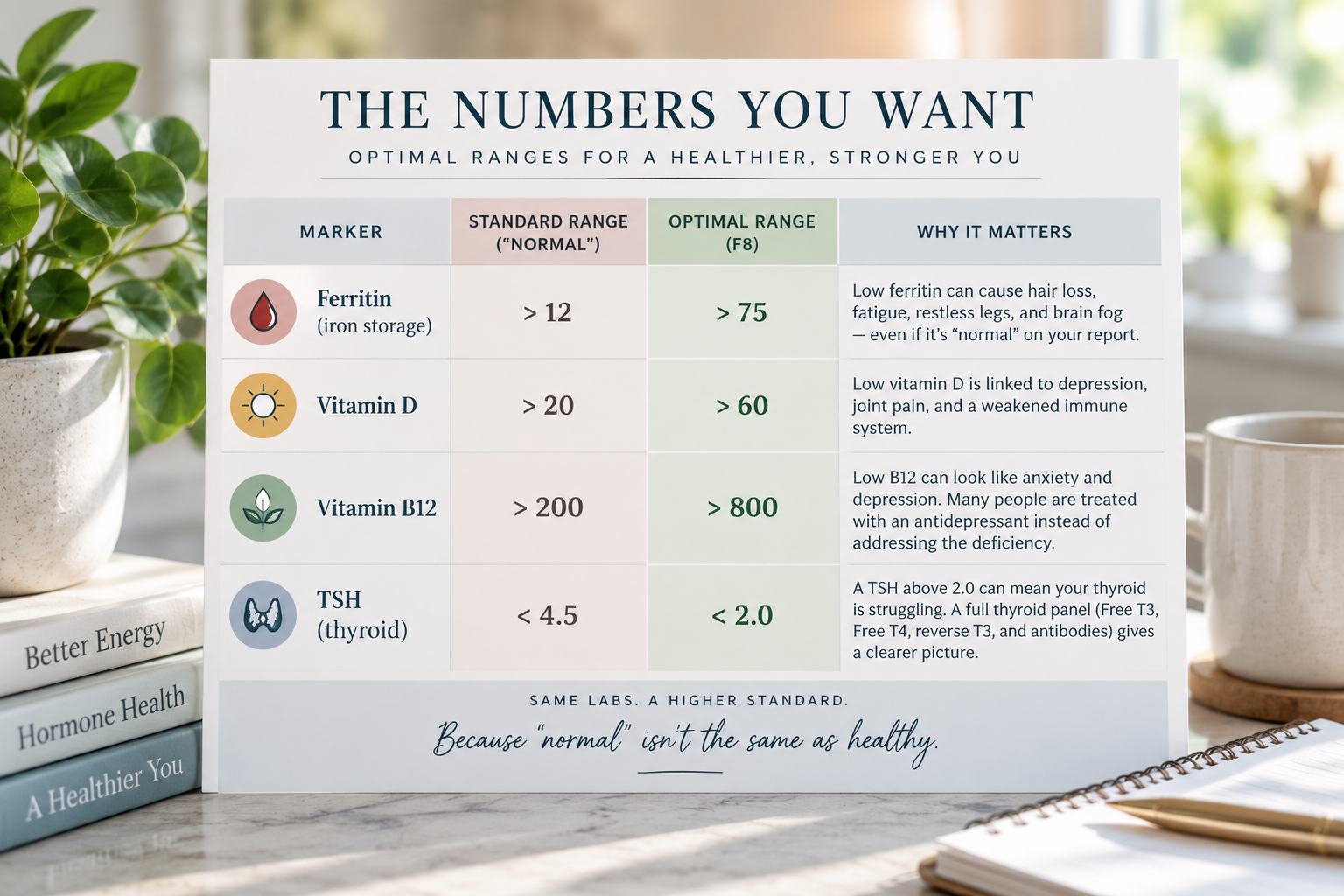
This is where it gets concrete. These are the optimal ranges we use at F8. Not the standard ranges. The ranges that actually correspond to a body that functions.
Ferritin. The standard range calls anything above 12 normal. We want ferritin above 75. At 14, your hair falls out, your legs will not stop moving at night, and you cannot think straight by 2 in the afternoon. At 14, your doctor calls you fine.
Vitamin D. The standard range calls anything above 20 acceptable. We want it above 60. At 22, we see chronic depression, joint pain, and immune dysfunction that has been going on for years with no explanation.
B12. The standard range calls anything above 200 normal. At 250, a person can be symptomatic. We want B12 above 800. B12 deficiency looks identical to anxiety and depression. Most of those patients are on an SSRI instead of a B12 protocol.
TSH. Called normal anywhere under 4.5. A TSH of 3.8 can mean your thyroid is struggling, and your doctor sees a number inside the box and moves on. When we add free T3, reverse T3, and antibodies to that picture, we find out whether the hormone is actually getting to the cells or whether the conversion is broken halfway there.
None of these labs are exotic. None of them require a specialist. They just require someone who knows what optimal looks like instead of what average looks like.
You were not failed by your body. You were failed by an incomplete test read against the wrong standard.
Go Check Right Now
Go to your patient portal right now. Pull up your most recent bloodwork. Find the actual numbers.
Check these four first.
Ferritin. If your result is under 75, your doctor called you normal, and your body is running on fumes.
Vitamin D. If your result is under 60, your immune system, your mood, and your energy have been paying for it.
B12. If your result is under 800, you may have been treating a nutrient deficiency with an antidepressant.
TSH. If your result is above 2, your thyroid may be working harder than it should have to.
Write down every number that falls outside those ranges. Take it to your next appointment and ask how you can improve these numbers.
If your provider cannot engage with that question, you are not in the right system. A functional medicine provider who interprets labs against optimal ranges will know exactly what those numbers mean and exactly what to do about them.
Final Thoughts
You came in with a clean bill of health but a body that told you something different. Now you know why both of those things were true at the same time. The labs were not lying. It’s just that normal and healthy don’t mean the same thing.
If you want to understand why your thyroid medication may be doing exactly what it was designed to do and still not fixing what is wrong with you, schedule bloodwork with F8 Wellness today.